7С
In brief:
- Continuous Development (reviewing the product idea, planning development, breaking tasks into subtasks). Tools: Jira, Git
Here is how the DevOps lifecycle is typically illustrated. It includes many phases we have already covered, but also introduces new ones such as Release, Operate, and Monitor:
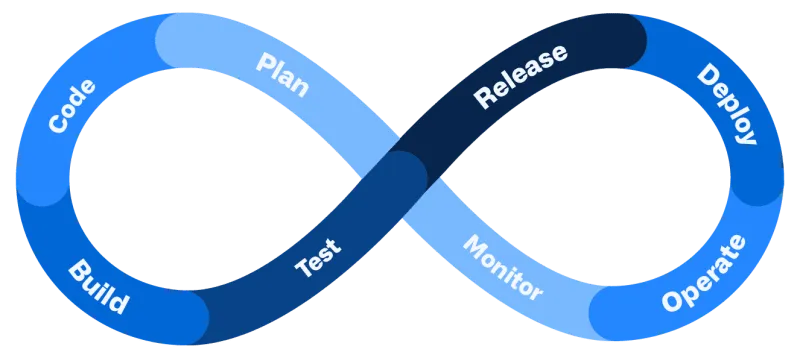
The DevOps lifecycle can also be described using seven "C"s:
- Continuous Development, (ideas and planning, breaking tasks into small subtasks) aimed at planning all processes.
Phases
- Planning;
- Writing code.
Practices
- Agile planning (using Jira for example);
- Sprint planning;
- Code versioning (git).
- Continuous Integration. This is one of the key phases where the team writes code, tests, and conducts code reviews to ensure the code is properly integrated with the existing codebase.
Practices
- Unit testing;
- Integration testing;
- Testing in a dev environment;
- Code review;
- Pull requests;
- Quality assurance.
- Continuous Testing. After code integration, continuous testing takes place to verify functionality and detect bugs.
Phases
- Building the product;
- Testing.
Practices
- Automated testing;
- UI tests.
- Continuous Deployment, which involves automated promotion of changes to production after successful testing.
Phases
- Deployment;
- Operation.
Practices
- Automated release pipelines;
- Automated code deployment;
- Automated infrastructure deployment;
- Infrastructure as Code;
- Automated quality and security checks;
- Automated rollbacks.
- Continuous Feedback. It is important to maintain continuous feedback from users to account for their requirements and opinions.
Practices
- A/B testing;
- Feature flags;
- User feedback.
- Continuous Operations. This phase is about configuring automated releases so that version updates do not require downtime -- a period when the application is unavailable to customers.
Practices
- Zero-downtime releases.
- Continuous Monitoring. This is the phase where monitoring, logging, error analysis, and system recovery after failures take place.
Phases
- Monitoring.
Practices
- Monitoring;
- Logging;
- Alerting;
- Incident management;
- Postmortems;
- Auto-failover;
- Auto-scaling.